
What Is an Industrial Robot? Complete Guide for Modern Manufacturing
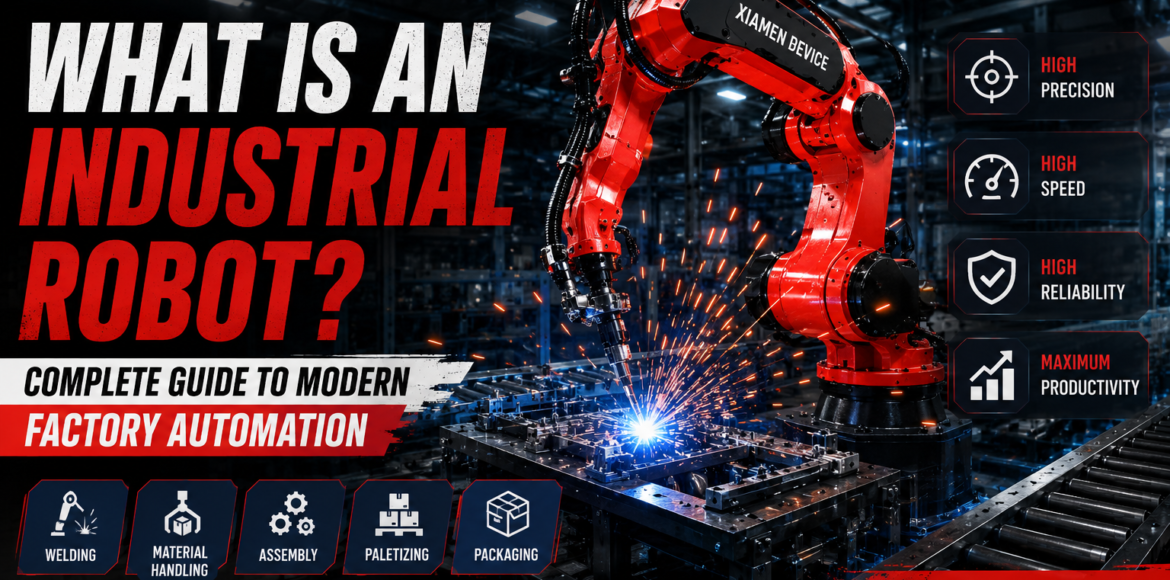
What Is an Industrial Robot? If you spend any time on a factory floor today, you’ve probably noticed the same thing plant managers have been noticing for the last decade: the work that used to require three shifts of manual labor is increasingly done by a robotic arm that doesn’t take breaks, doesn’t get tired, and doesn’t make the same mistake twice.
That’s the short version of why industrial robots matter. The longer version — what they actually are, how they work, which type fits which job, and what it takes to bring one onto your production line — is what this guide covers.
An industrial robot is a programmable, multi-axis mechanical system used to automate tasks such as welding, assembly, material handling, packaging, and machine tending. Unlike a fixed automation fixture that can only do one thing, an industrial robot can be reprogrammed and retooled to handle a range of tasks, which is exactly why it has become the backbone of modern manufacturing.
Robots matter more now than they did five years ago because manufacturers are dealing with three pressures at once: rising labor costs, persistent skilled-labor shortages, and customers who expect tighter tolerances and faster turnaround. Robotic automation is one of the few levers that addresses all three simultaneously. It’s also central to the broader shift toward Industry 4.0, where robots are connected to sensors, production data systems, and quality control software rather than operating as isolated machines.
In this guide, you’ll learn:
- What an industrial robot actually is, using the ISO definition
- How a robot’s controller, motors, sensors, and end effector work together
- The six major types of industrial robots and where each one fits
- Real-world applications across ten industries
- The genuine benefits and the real challenges of adopting robotics
- How industrial robots differ from collaborative robots
- A practical framework for choosing the right robot for your application
Whether you’re a production manager evaluating your first robotic work cell or a procurement lead comparing suppliers, this guide is built to give you a working understanding — not just marketing language.
What Is an Industrial Robot?
In plain terms, an industrial robot is a reprogrammable machine built to perform physical tasks — moving, lifting, welding, assembling, or inspecting parts — with a level of precision and repeatability that manual labor or simple fixed automation cannot consistently match.
The International Organization for Standardization (ISO 8373) defines an industrial robot as an automatically controlled, reprogrammable, multipurpose manipulator, programmable in three or more axes, which can be either fixed in place or mobile for use in industrial automation applications. Three words in that definition matter more than the rest:
- Automatically controlled — it operates without a human directly guiding each movement
- Reprogrammable — its task can be changed without rebuilding the hardware
- Multipurpose — it isn’t built to do only one job forever
Industrial Robots vs. Traditional Automation
This is where a lot of confusion happens, especially for teams evaluating automation for the first time. A pneumatic pick-and-place fixture or a hard-tooled conveyor system is also “automation,” but it’s not a robot in the ISO sense.
| Factor | Traditional Fixed Automation | Industrial Robot |
|---|---|---|
| Flexibility | Built for one task; hard to modify | Reprogrammable for multiple tasks |
| Setup for new products | Requires new tooling/fixtures | Often just reprogramming + end-of-arm tooling change |
| Axes of motion | Usually 1–2 | 3 to 7+ |
| Upfront cost | Lower for single-task lines | Higher, but amortized across product changes |
| Best fit | High-volume, unchanging product | Mixed production, frequent changeovers |
Neither approach is universally “better” — a high-volume bottling line may still be more cost-effective with fixed automation. Robots earn their value when flexibility, precision, or complex motion paths are required.
How Industrial Robots Work
An industrial robot is a system, not a single device. Five subsystems work together every time the arm moves.
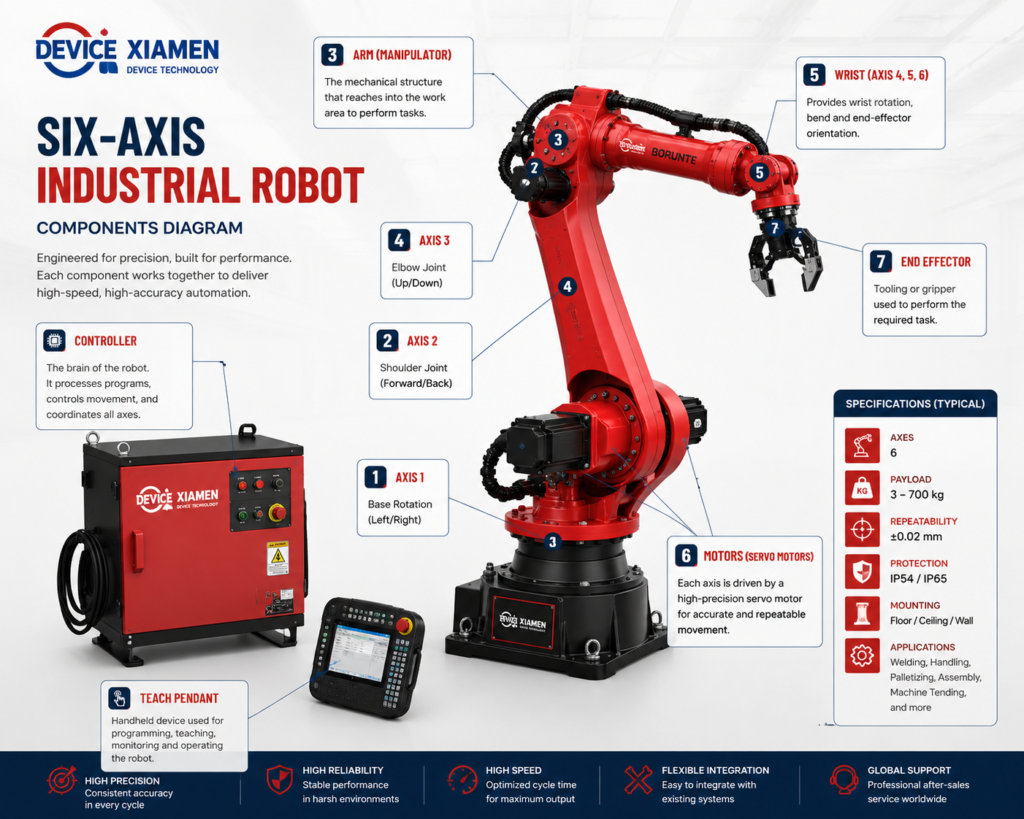
- Controller — the “brain” that executes the program, calculates motion paths, and coordinates every axis in real time.
- Servo motors — drive each joint (axis) of the robot with precise position and speed control.
- Sensors — encoders track joint position; force/torque, vision, and proximity sensors provide feedback about the task and environment.
- End-of-arm tooling (EOAT) — the gripper, welding torch, suction cup, or spray gun attached to the robot’s wrist, chosen based on the application.
- Programming interface — typically a teach pendant or offline simulation software used to define the robot’s motion path and logic.
A Simple Workflow
A typical robotic task follows this sequence:
- The controller loads the programmed job.
- Sensors confirm the part or workpiece is in position.
- Servo motors move the arm along the calculated path.
- The end effector performs the task (grip, weld, place, etc.).
- Sensors verify task completion (position check, vision inspection, force feedback).
- The controller logs the cycle and prepares for the next one.
Callout: Why Motion Control Matters The difference between an entry-level robot and a precision robot often isn’t the motor — it’s the quality of the motion control algorithm. Smooth acceleration and deceleration profiles reduce vibration, protect the mechanical structure, and directly improve repeatability, especially in high-speed pick-and-place or welding applications.
Main Components of an Industrial Robot
Understanding the individual components helps when comparing specifications between manufacturers, since not all “6kg payload” robots are built with the same quality of internals.
| Component | Purpose | Importance |
|---|---|---|
| Controller | Executes the program and coordinates motion across all axes | Determines speed, precision, and integration capability |
| Robot Arm | The mechanical structure that carries the payload through its workspace | Defines reach, payload capacity, and rigidity |
| Motors (Servos) | Drive each joint with controlled torque, speed, and position | Directly affects repeatability and cycle time |
| Sensors | Provide position, force, or vision feedback | Enables quality control and adaptive behavior |
| Teach Pendant | Handheld device for programming and jogging the robot | Affects ease of programming and operator training time |
| End Effector | Task-specific tool (gripper, welder, spray nozzle) mounted on the wrist | Determines what the robot can physically do |
| Software | Offline programming, simulation, and fleet management tools | Reduces downtime and simplifies changeovers |
Types of Industrial Robots
Not every job needs the same kind of robot. The right configuration depends on the motion path, payload, speed, and workspace your application requires.
Six-Axis Robot
Six-axis (articulated) robots have six rotating joints, giving them motion flexibility close to a human arm.
How it works: Each joint rotates independently, allowing the arm to approach a part from nearly any angle.
Advantages:
- Widest range of motion and orientation flexibility
- Handles complex 3D paths (welding seams, spray coating)
- Available in payloads from a few kilograms to over a ton
Disadvantages:
- More complex programming than simpler robot types
- Higher cost for high-payload models
- Larger footprint than SCARA or Delta robots for comparable reach
Applications: Arc and spot welding, material handling, painting, machine tending, complex assembly. (Internal link suggestion: Six-Axis Robot page)
SCARA Robot
SCARA (Selective Compliance Assembly Robot Arm) robots have four axes and move in a horizontal plane with a vertical Z-axis stroke.
How it works: Two parallel rotary joints move the arm horizontally; a third axis drives vertical motion; a fourth rotates the wrist.
Advantages:
- Very fast cycle times for horizontal pick-and-place
- Rigid in the vertical direction — good for insertion tasks
- Smaller footprint, cost-effective for light payloads
Disadvantages:
- Limited to a largely 2.5D motion envelope
- Not suited for complex 3D paths or overhead work
Applications: Electronics assembly, PCB handling, small parts insertion, dispensing. (Internal link suggestion: SCARA Robot page)
Delta Robot
Delta (parallel-link) robots suspend the end effector from three arms connected to a common base, forming a spider-like structure above the work area.
How it works: Three motors control parallel linkages that move the end effector in a small, fast triangular workspace beneath the base.
Advantages:
- Extremely high speed, ideal for high-frequency picking
- Lightweight moving parts reduce inertia and wear
- Good for hygienic environments (food, pharma)
Disadvantages:
- Small working envelope compared to other robot types
- Typically limited to lighter payloads
- Overhead mounting requires specific cell design
Applications: Food packaging, pharmaceutical sorting, high-speed pick-and-place on conveyors. (Internal link suggestion: Delta Robot page)
Collaborative Robot (Cobot)
Collaborative robots are designed to work safely alongside human operators without full safety fencing, using force-limiting technology and safety-rated monitoring.
How it works: Built-in force/torque sensing lets the robot detect unexpected contact and stop or reduce force, allowing shared workspace with people.
Advantages:
- Faster deployment; often no need for full guarding
- Easier programming, frequently via hand-guiding
- Good for low-to-mid volume, flexible production
Disadvantages:
- Generally slower and lower payload than industrial six-axis robots
- Speed/payload trade-off due to safety requirements
- Not ideal for high-volume, high-speed lines
Applications: Machine tending, small parts assembly, quality inspection, tasks with frequent human interaction. (Internal link suggestion: Collaborative Robot page)
Cartesian Robot
Cartesian (gantry) robots move along three linear axes — X, Y, and Z — at right angles to each other.
How it works: Linear actuators or belt-driven rails move the end effector along straight-line paths in each axis.
Advantages:
- High rigidity and repeatability over large work areas
- Simple to program with straightforward linear motion
- Scalable to very large workspaces (overhead gantries)
Disadvantages:
- Larger physical footprint
- Less suited to complex angled or rotational motion
Applications: CNC machine tending, palletizing, large-format material handling, 3D printing gantries.
Palletizing Robot
Palletizing robots are typically heavy-payload six-axis or Cartesian robots optimized for stacking cases, bags, or boxes onto pallets.
How it works: The robot picks products from a conveyor or infeed point and places them onto a pallet in a pre-programmed pattern, often optimized for stability and space usage.
Advantages:
- Handles heavy, repetitive lifting without operator fatigue or injury risk
- Consistent stacking patterns improve pallet stability for shipping
- Can run continuously across shifts
Disadvantages:
- Requires adequate floor space and infeed/outfeed conveyor integration
- Payload and reach must be matched carefully to product size
Applications: End-of-line packaging, warehouse and logistics operations, bagged goods stacking. (Internal link suggestion: Palletizing Robot page)
Industrial Robot Applications
Industrial robots are no longer confined to automotive plants. Here’s how different industries use them today.
| Industry | Common Robot Applications |
|---|---|
| Automotive | Spot welding, arc welding, painting, chassis assembly |
| Electronics | PCB assembly, component placement, soldering, testing |
| Food & Beverage | Packaging, sorting, palletizing, hygienic pick-and-place |
| Packaging | Case packing, palletizing, carton erecting, labeling |
| Injection Molding | Part removal, insert molding, degating, machine tending |
| Metal Fabrication | Welding, deburring, material handling, press tending |
| CNC Machine Tending | Loading/unloading parts, tool changing support |
| Logistics & Warehousing | Palletizing, depalletizing, order picking, sorting |
| Pharmaceutical | Sterile handling, packaging, sorting, quality inspection |
| Medical Devices | Precision assembly, dispensing, inspection, packaging |
Benefits of Industrial Robots
The case for robotics comes down to consistent, measurable operational gains:
- Higher productivity — robots run at consistent cycle times without fatigue-related slowdowns
- Better quality — repeatable motion paths reduce variation between parts
- Improved safety — robots take on hazardous tasks like heavy lifting, welding fumes exposure, or repetitive strain-prone motions
- Lower long-term labor costs — particularly valuable where skilled labor is scarce or turnover is high
- 24/7 operation capability — robots can run unattended across multiple shifts where the process allows
- Consistent accuracy — repeatability specs (often ±0.02–0.1 mm depending on the robot class) remain stable over millions of cycles
- Higher ROI over time — amortized across product lifecycles and multiple product changeovers
- Scalability — additional robots or work cells can be added as production volume grows
Callout: ROI Isn’t Instant A common mistake is expecting payback within months. Most industrial robot deployments realistically show ROI within 1–3 years, depending on labor costs, shift patterns, and application complexity. Treat robotics as a capital investment decision, not a quick fix.
Challenges of Industrial Robots
Robotics adoption isn’t without friction. Being upfront about the challenges is part of making a sound decision.
- Initial investment — robot, end effector, safety equipment, and integration costs add up beyond the base unit price
- Programming — complex applications require skilled programmers or integrators, especially for multi-robot cells
- Maintenance — servo motors, gearboxes, and controllers need scheduled maintenance to avoid unplanned downtime
- Training — operators and maintenance staff need training on both the robot and the safety systems around it
- Integration — robots must work with existing conveyors, PLCs, vision systems, and plant software
- Safety compliance — fixed robots typically require guarding and risk assessments per ISO 10218 and ISO/TS 15066 for cobots
How companies overcome these challenges:
- Partnering with an experienced systems integrator or manufacturer that provides application engineering support
- Starting with a pilot cell on one production line before scaling
- Using offline simulation software to reduce programming time and downtime
- Standardizing on a robot platform across the plant to simplify spare parts and training
Industrial Robots vs Collaborative Robots
This is one of the most common questions from teams evaluating automation for the first time.
| Factor | Industrial (Six-Axis) Robot | Collaborative Robot |
|---|---|---|
| Speed | High | Moderate to low |
| Payload | Wide range, including heavy payloads | Typically lighter payloads |
| Safety guarding | Usually required (fencing/light curtains) | Often works without full guarding |
| Programming | More complex, integrator-dependent | Simpler, often hand-guided |
| Best for | High-volume, high-speed production | Flexible, low-to-mid volume tasks near people |
| Footprint | Larger, dedicated cell | Compact, can share workspace |
| Typical cost | Higher for comparable payload | Generally lower entry cost |
Neither is a universal replacement for the other — many modern plants use both: industrial robots for high-throughput lines and cobots for flexible, human-adjacent tasks like final assembly or inspection.
How to Choose the Right Industrial Robot
Selecting a robot isn’t about picking the fastest or highest-payload option — it’s about matching specifications to your actual application. Work through these factors:
- Payload — the maximum weight the robot can carry, including the end effector, with margin for dynamic loads
- Reach — the maximum horizontal distance the arm can extend, which must cover your entire workspace
- Speed — maximum axis speed, which affects cycle time but must be balanced against precision needs
- Accuracy and repeatability — how consistently the robot returns to the same position, critical for tight-tolerance work
- Workspace and footprint — floor space, mounting orientation (floor, wall, ceiling), and clearance for peripheral equipment
- Industry-specific requirements — washdown ratings for food/pharma, cleanroom compatibility for electronics/medical
- Budget — total cost of ownership, including integration, tooling, training, and maintenance — not just the unit price
- Integration complexity — compatibility with existing PLCs, conveyors, vision systems, and safety infrastructure
- Future expansion — whether the robot platform can scale to new products or higher volumes without a full re-buy
Callout: A Practical Rule of Thumb When specs seem close between two robots, the deciding factor is usually integration and support — not the datasheet. A robot backed by strong application engineering and local technical support often outperforms a marginally faster robot with poor integration assistance.
Why Choose Xiamen Technology as Your Industrial Robot Manufacturer
Selecting an industrial robot manufacturer is as important as selecting the robot itself, since the relationship extends well beyond the initial purchase.
Xiamen Technology approaches robotics from an engineering-first perspective, with experience across industrial automation applications including material handling, machine tending, welding, and packaging. Key considerations for manufacturers evaluating a robotics partner include:
- Engineering expertise — robotics engineers who understand both the mechanical and control-system sides of a deployment
- Industrial automation experience — familiarity with real production environments, not just lab conditions
- Complete robot solutions — robots, controllers, and compatible end-of-arm tooling designed to work together
- Application engineering — support in matching robot specifications to your specific process requirements
- Custom integration — working with your existing conveyors, PLCs, and safety systems rather than forcing a rebuild
- Technical support — availability of support during commissioning and ongoing operation
- Global delivery — logistics and support capability for manufacturers operating across regions
The right manufacturer partner reduces the risk in your automation project — from initial specification through commissioning and long-term maintenance. (Internal link suggestion: Industrial Robot Manufacturer page, Contact page)
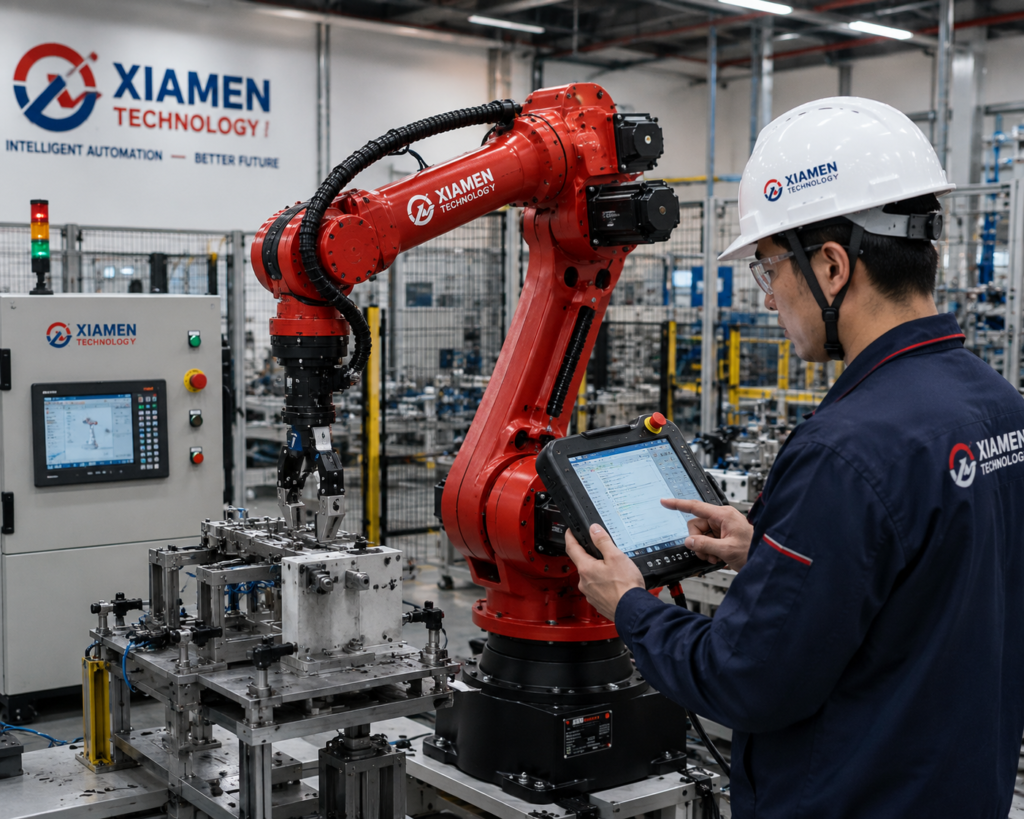
Suggested image: Xiamen Technology engineer commissioning a six-axis industrial robot on a factory floor. Alt text: “Xiamen Technology engineer setting up an industrial robot for a manufacturing application.”
Frequently Asked Questions
What is an industrial robot?
An industrial robot is a programmable, multi-axis mechanical system used to automate manufacturing tasks such as welding, assembly, and material handling.
How do industrial robots work?
They work through a combination of a controller, servo motors, sensors, and end-of-arm tooling, all coordinated to execute a programmed motion path.
What are industrial robots used for?
Common uses include welding, material handling, packaging, palletizing, machine tending, assembly, and quality inspection.
What industries use industrial robots?
Automotive, electronics, food and beverage, pharmaceuticals, metal fabrication, logistics, and medical device manufacturing are among the largest users.
How much does an industrial robot cost?
Costs vary widely based on payload, reach, and application complexity, and total project cost typically includes the robot, end effector, integration, and safety equipment beyond the base unit price.
What is the difference between SCARA and six-axis robots?
SCARA robots move in a horizontal plane with a vertical stroke and excel at fast, simple pick-and-place, while six-axis robots offer full 3D motion flexibility for complex paths like welding or spray coating.
What is robot payload?
Payload is the maximum weight a robot can safely carry at its wrist, including the end effector, while maintaining rated speed and accuracy.
How accurate are industrial robots?
Repeatability varies by robot class, but many industrial robots achieve repeatability in the range of ±0.02 to ±0.1 mm depending on size and design.
What are the advantages of industrial robots?
Key advantages include higher productivity, improved quality consistency, reduced workplace injury risk, and the ability to run extended shifts without fatigue.
What is a collaborative robot (cobot)?
A cobot is a robot designed with force-limiting and safety features that allow it to work in shared spaces with human operators, often without full safety fencing.
Do industrial robots require safety fencing?
Traditional industrial robots typically require guarding per ISO 10218, while collaborative robots may operate without full fencing if a proper risk assessment supports it.
How long does it take to deploy an industrial robot?
Deployment timelines vary by application complexity, but typically range from a few weeks for simple pick-and-place cells to several months for complex, multi-robot integration projects.
Can industrial robots be reprogrammed for new products?
Yes — re programmability is a defining feature of industrial robots, which is what distinguishes them from fixed automation built for a single task.
What is the difference between a Delta robot and a SCARA robot?
Delta robots use an overhead parallel-link design optimized for very high-speed picking in a small workspace, while SCARA robots use a horizontal arm design suited to insertion and assembly tasks.
Who is a leading industrial robot manufacturer?
Manufacturers are typically evaluated on engineering expertise, application experience, and integration support — factors that distinguish established industrial robot manufacturers like Xiamen Technology.
Conclusion
An industrial robot is, at its core, a reprogrammable manipulator built to bring precision, consistency, and flexibility to manufacturing tasks that were once limited by manual labor or rigid fixed automation. Understanding the components, robot types, and application fit is the foundation for making a sound automation decision — whether you’re deploying your first cobot for light assembly or specifying a heavy-payload six-axis robot for a welding line.
The right choice depends on your payload, speed, accuracy, and integration requirements — and on partnering with a manufacturer who understands your production environment, not just the robot’s datasheet.