
Industrial Robot Integration: How to Build a Complete Automation System
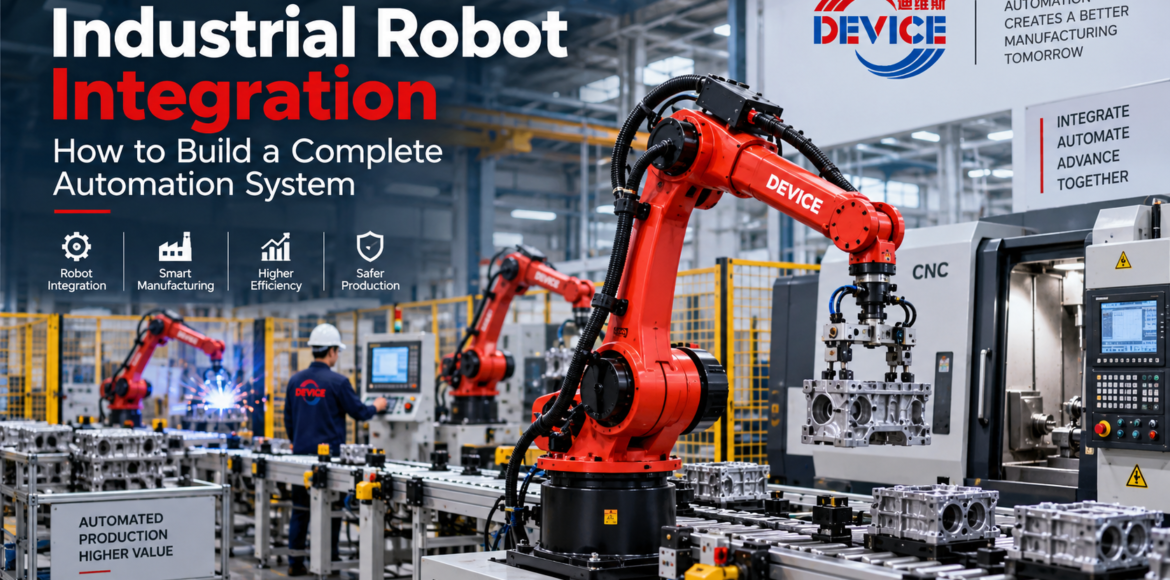
Industrial automation is no longer simply about installing a robot arm beside a production machine. For a robotic system to deliver real value, the robot needs to work together with tooling, machines, sensors, controls, safety systems and the manufacturing process itself.
That is where industrial robot integration becomes important.
Industrial robot integration is the process of connecting an industrial robot with the equipment, software and control systems required to perform a specific manufacturing task. Depending on the application, this can involve robot selection, end-of-arm tooling, PLC communication, conveyors, sensors, vision systems, safety equipment, programming, testing and commissioning.
For manufacturers considering automation, understanding integration is just as important as choosing the right robot.
A robot with the right payload and reach can still underperform if the tooling is unsuitable, the production layout is inefficient or the robot cannot communicate properly with the surrounding equipment.
The objective should therefore be simple: build an automation system around the production process, not simply purchase a robot and work out the rest later.
What Is Industrial Robot Integration?
Industrial robot integration is the engineering process of combining a robot with tooling, machines, controls, sensors, safety equipment and software to create a functioning automated production cell.
A typical integrated robotic system may include:
| System Component | Main Function |
|---|---|
| Industrial robot | Performs programmed movements |
| Robot controller | Controls robot motion and operation |
| End-of-arm tooling | Handles or processes the workpiece |
| PLC | Coordinates the automation sequence |
| Sensors | Detect parts, positions and machine conditions |
| Conveyor | Transfers products or components |
| Vision system | Identifies, locates or inspects parts |
| Safety system | Helps protect people working around the cell |
| HMI | Allows operators to monitor and interact with the system |
| Production machine | Performs machining, molding or another process |
| Robot software | Controls movement and production sequences |
Not every application needs all of these components.
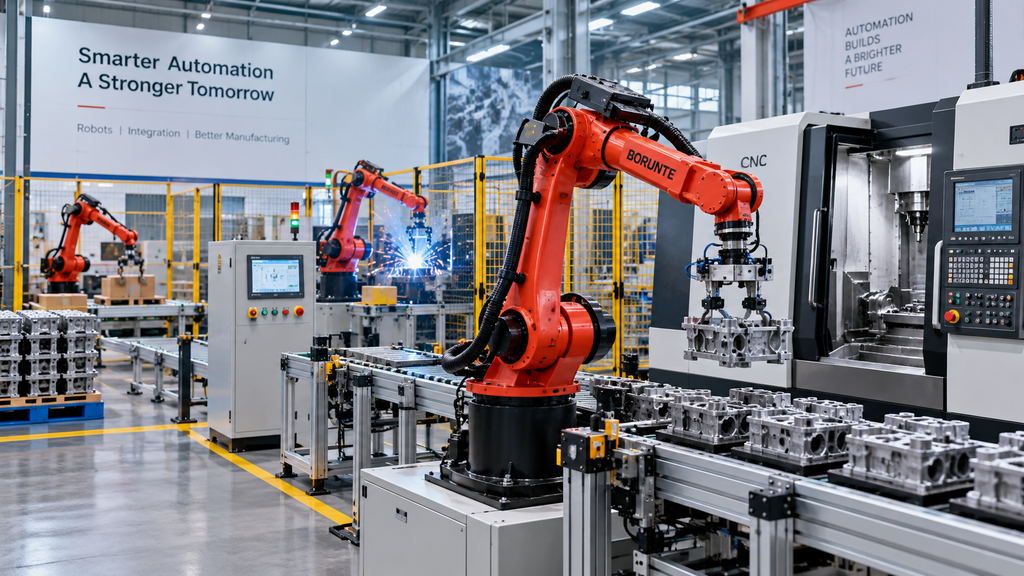
A simple pick-and-place system may only require a robot, gripper, conveyor and sensors. A complex CNC machine-tending cell may require multiple machines, PLC communication, custom tooling, safety equipment and more advanced programming.
This is why there is no single standard configuration for every robotic system integration project.
The system needs to be designed around the product, process, production volume and required cycle time.
Why Is Industrial Robot Integration Important?
A standalone robot can perform programmed movements, but manufacturing automation usually requires much more than robot motion.
Consider a CNC machine-tending application.
The robot may need to:
- Receive a signal that the machine is ready.
- Pick the correct component.
- Position the component accurately.
- Load it into the machine.
- Confirm that loading is complete.
- Wait while machining takes place.
- Remove the finished component.
- Place it at the next station.
- Confirm the sequence before beginning another cycle.
The robot, machine, gripper, sensors and control system all need to communicate correctly.
If one part of that sequence fails, the entire production cycle can stop.
This is why professional industrial robot integration focuses on the complete production process rather than the robot alone.
A successful integration project should consider not only whether the robot can perform the movement, but whether the entire cell can perform the required task repeatedly, safely and efficiently.
What Does an Industrial Robot Integration System Include?
A complete integration project can involve mechanical, electrical, controls and software engineering.
Robot Selection
Robot selection should be based on the actual application.
Important considerations include:
- Payload
- Reach
- Repeatability
- Speed
- Cycle time
- Mounting configuration
- Working envelope
- Environmental conditions
- Required degrees of freedom
Payload also needs careful consideration.
If a workpiece weighs 15 kg and the gripper weighs 5 kg, the robot is not handling a 15 kg load. The complete payload needs to be considered when selecting the appropriate robot.
The same principle applies to reach. A robot may have sufficient payload capacity but still be unsuitable if it cannot access the required machine, fixture or conveyor positions.
End-of-Arm Tooling
The robot is only as effective as the tool interacting with the product.
Depending on the application, the end-of-arm tool may be:
- Mechanical gripper
- Vacuum gripper
- Welding torch
- Dispensing tool
- Screwdriving tool
- Cutting tool
- Polishing tool
- Magnetic gripper
- Custom handling fixture
Tooling should be designed around the workpiece.
For example, a gripper for a small electronic component will have very different requirements from a gripper handling a heavy automotive component.
The tool also affects payload, cycle time, accessibility and overall system reliability.
PLC and Machine Integration
Most industrial robots operate as part of a larger automation system.
The robot may need to exchange information with:
- PLCs
- CNC machines
- Injection molding machines
- Presses
- Conveyors
- Sensors
- Vision systems
- Safety controllers
- HMIs
This communication allows the different pieces of equipment to operate in a coordinated sequence.
Depending on the equipment and application, communication may involve industrial protocols such as EtherCAT, Modbus TCP or PROFINET.
The important point is not simply which communication protocol is used. The integration needs to ensure that the robot and surrounding equipment exchange the right signals at the right time.
Sensors and Vision Systems
Sensors provide the robot cell with information about the production environment.
They can be used to detect:
- Part presence
- Part position
- Conveyor status
- Machine status
- Fixture position
- Safety-door status
- Product arrival
Vision systems can provide additional information when parts need to be identified, located or inspected.
For example, if components arrive in different orientations, a vision system can help determine their position before the robot performs the handling operation.
This can make robotic automation more flexible than a system relying only on fixed positions.
Where Is Industrial Robot Integration Used?
Industrial robot integration is used across many manufacturing processes.
Welding Automation
Robotic welding is a common industrial application where the robot works together with welding equipment, fixtures, positioners and safety systems.
The robot must follow the required path while the workpiece is held consistently and the welding process operates at the appropriate time.
A properly integrated welding cell can provide repeatable movements and help maintain consistent production conditions.
Machine Tending
Machine tending involves using robots to automatically load and unload production equipment.
Common applications include:
- CNC machining
- Turning
- Pressing
- Grinding
- Metal processing
- Other automated machine operations
The robot needs to know when the machine is ready, when it is safe to enter, when the machining cycle has finished and when the completed part can be removed.
That makes machine tending a strong example of why robot integration solutions need to include both robot programming and machine communication.
Material Handling
Material handling robots move components or products between different production stages.
Applications include:
- Pick and place
- Part transfer
- Loading
- Unloading
- Sorting
- Component handling
- Production-line transfer
The system may combine a robot with conveyors, sensors, grippers and PLC controls.
The objective is to create a continuous and predictable material flow rather than simply automate one movement.
For a broader look at where robots are used in manufacturing, see our guide to industrial robot applications.
Robotic Palletizing
Palletizing automation is used to arrange products onto pallets according to a programmed pattern.
A typical palletizing cell can include:
- Industrial robot
- Product conveyor
- Gripper
- Pallet station
- Sensors
- Pallet pattern programming
- Safety equipment
The appropriate robot and gripper depend on product weight, dimensions, pallet configuration and required production speed.
Assembly Automation
Industrial robots can also perform repetitive assembly tasks such as:
- Component insertion
- Part positioning
- Screwdriving
- Press fitting
- Adhesive dispensing
- Product transfer
The correct robot depends on the required speed, precision, payload and workspace.
For applications requiring fast and precise component movement, different robot architectures may be considered depending on the process.
Injection Molding Automation
Injection molding applications have their own automation requirements.
Robotic manipulators can be used for:
- Part removal
- Insert handling
- Product transfer
- In-mold operations
- Placement onto conveyors
The manipulator needs to be synchronized with the molding machine’s cycle.
In these applications, timing is particularly important because the robot must complete its operation within the required production window.
How Does Industrial Robot Integration Work?
A successful project normally follows a structured process.
1. Analyze the Production Process
The first step is understanding what the manufacturer actually needs to automate.
Important questions include:
- What product is being handled?
- How much does it weigh?
- What are its dimensions?
- How many parts are produced per hour?
- What cycle time is required?
- Which machines already exist?
- How much floor space is available?
- How often will operators interact with the cell?
- What quality requirements need to be maintained?
This application assessment provides the foundation for the rest of the project.
2. Define the Automation Objective
The automation objective should be measurable.
For example:
Automatically load and unload a CNC machine while maintaining the required production cycle and ensuring safe operator access.
This is much more useful than simply saying:
We need a robot.
Once the objective is clear, engineers can determine the robot type, tooling, controls and supporting equipment required.
3. Select the Appropriate Robot
Robot selection should follow the application assessment.
The engineering team should evaluate:
Payload + Reach + Cycle Time + Repeatability + Tooling + Workspace
The robot also needs to access all required positions without creating unnecessary movements.
For an overview of different robot architectures, manufacturers can compare the types of industrial robots used for different applications.
4. Design the Robotic Workcell
The physical layout of the cell is another important part of integration.
The design should account for:
- Robot location
- Machine location
- Conveyor position
- Operator access
- Maintenance access
- Material flow
- Tooling
- Safety boundaries
- Component presentation
A poorly planned layout can increase robot travel distance and create unnecessary production delays.
A well-designed workcell allows the robot and surrounding equipment to operate efficiently within the available space.
5. Integrate the Equipment
Once the cell design is established, the different components need to work together.
This may include:
- PLC communication
- CNC communication
- Conveyor control
- Sensor integration
- Vision integration
- Tool control
- Safety circuits
- HMI communication
The goal is to create one coordinated system rather than a collection of separate machines.
6. Program the Robot
Robot programming determines how the system performs the production sequence.
Programming can include:
- Robot positions
- Movement paths
- Speeds
- Acceleration
- Tool operation
- Sensor inputs
- Machine signals
- Production sequences
- Error handling
- Recovery procedures
A robust program should consider both normal production and abnormal situations.
For example, what should happen if a part is missing?
What happens if the machine does not complete its cycle?
What happens if a sensor does not provide the expected signal?
These situations should be considered during integration and testing.
7. Test and Commission the System
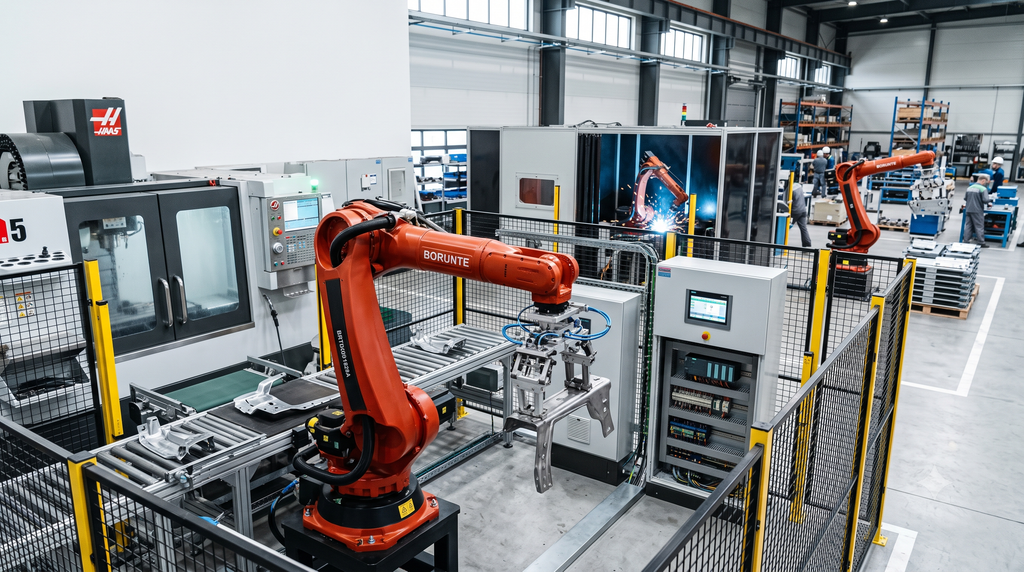
Before production begins, the complete cell needs to be tested.
Testing may cover:
- Robot movement
- Tool operation
- Sensor response
- PLC communication
- Machine communication
- Safety functions
- Production sequence
- Cycle time
- Error recovery
- Operator interaction
Commissioning is the stage where the system is validated against the actual production requirement.
Why Robot Safety Must Be Part of Integration
Safety should be considered during system design, not added after installation.
An industrial robot cell may contain several moving and potentially hazardous elements, including the robot, tooling, conveyors and production machines.
ISO 10218-2:2025 addresses safety requirements for the integration, commissioning, operation, maintenance and decommissioning of industrial robot applications and robot cells. ISO 10218-2:2025
Depending on the application, a robotic workcell may require:
- Safety guarding
- Interlocked access doors
- Emergency stops
- Safety-rated controls
- Presence detection
- Risk assessment
- Safe maintenance procedures
- Operator training
Safety requirements vary according to the application, equipment and jurisdiction.
For additional workplace robotics safety information, manufacturers can refer to OSHA Robotics Safety Resources.
One important consideration is that hazards are not limited to normal robot operation. Programming, testing, maintenance, setup and adjustment can also introduce risks.
What Are the Benefits of Industrial Robot Integration?
When properly engineered, robotic integration can provide benefits across the production process.
Improved Consistency
Robots can repeat programmed movements consistently, which can be useful for applications such as welding, assembly, handling and machine tending.
More Predictable Production
When robots, machines and material-handling equipment are coordinated, production sequences can become more structured and predictable.
Reduced Repetitive Handling
Robots can perform repetitive material movement and other physically demanding operations, allowing people to focus on tasks that require greater flexibility or decision-making.
Better Process Control
Sensors, PLCs, robot programs and machine interfaces allow manufacturers to control production sequences more systematically.
Easier Expansion
Once an automation process has been successfully developed, the concept may be adapted or expanded for additional production requirements.
However, the actual return from automation depends on the application, production volume, cycle time, system design and operating conditions.
What Can Go Wrong With Poor Robot Integration?
Not every automation problem is caused by the robot itself.
A project can encounter difficulties when:
- The robot is incorrectly sized.
- The gripper is unsuitable.
- The cycle time was underestimated.
- The workcell layout is inefficient.
- Existing machinery cannot communicate properly.
- Sensors are poorly positioned.
- Safety was considered too late.
- Operators are not adequately trained.
- Maintenance requirements were overlooked.
For example, imagine a robot that can easily carry the required workpiece but takes too long to move between positions.
Technically, the robot meets the payload requirement.
Operationally, the system may still fail to achieve the required production rate.
This is why an experienced industrial robot integrator looks at the complete process rather than evaluating robot specifications in isolation.
Industrial Robot Integration vs. Buying a Standalone Robot
There is an important difference between buying a robot and implementing an integrated robotic system.
| Standalone Robot | Integrated Robotic System |
|---|---|
| Focuses primarily on robot hardware | Focuses on the complete production process |
| Tooling may be sourced separately | Tooling is designed around the application |
| Integration may happen later | Integration is considered from the beginning |
| Machine communication may be separate | Robot and machines are coordinated |
| Programming may be handled separately | Programming is developed around the complete cell |
| Buyer may coordinate multiple suppliers | Integration partner can coordinate multiple elements |
| Commissioning may be separate | Complete system can be tested as one cell |
A manufacturer with an experienced internal automation team may prefer to purchase robot hardware and complete the integration internally.
For more complex projects, however, working with an industrial robot integration company can simplify the coordination of mechanical, electrical, controls, programming and commissioning requirements.
How to Choose an Industrial Robot Integration Company
The integration partner can have a significant influence on the final result.
Before selecting a supplier, manufacturers should look beyond the robot’s specifications.
Do They Understand Your Application?
The integrator should understand:
- Product characteristics
- Production volume
- Cycle time
- Existing equipment
- Factory layout
- Quality requirements
- Operator requirements
A supplier that recommends a robot before understanding the application may not be addressing the complete automation requirement.
Can They Handle Tooling?
The end-of-arm tool is often one of the most important parts of a robotic application.
Ask how tooling will be selected or designed and how it affects payload, reach and cycle time.
Can They Integrate Existing Machines?
If your factory already has CNC machines, injection molding machines, conveyors or other equipment, ask whether the integration team can connect those systems to the robot.
Do They Provide Programming and Commissioning?
A complete project should consider programming, testing and commissioning rather than stopping at robot delivery.
What Happens After Installation?
Long-term support can include:
- Operator training
- Maintenance guidance
- Spare parts
- Troubleshooting
- Technical assistance
- Preventive maintenance
- Remote support
These services become increasingly important as robotic automation becomes part of daily production.
For manufacturers comparing suppliers, our guide on how to choose an industrial robot supplier provides additional considerations.
Why Application-Based Robot Integration Matters
There is no single robot configuration that is ideal for every manufacturing application.
A welding cell has different requirements from a palletizing system.
A CNC machine-tending application has different requirements from high-speed pick-and-place.
Injection molding automation has different timing requirements from assembly.
This is why an application-first approach is more effective:
Application → Process Requirements → Robot Selection → Tooling → Integration → Programming → Safety → Commissioning
rather than:
Robot → Find a Use for It
Starting with the production requirement helps ensure that the robot and supporting equipment are selected for a specific purpose.
Industrial Robot Integration and Complete Automation Solutions
Robot integration is ultimately one part of a broader manufacturing automation strategy.A manufacturer may begin with one application, such as machine tending, and later automate additional processes including material handling, inspection, assembly or palletizing.
This is why manufacturers evaluating automation should consider the complete industrial robot solutions available for their production requirements rather than looking only at individual robot models.
A complete solution can bring together robot hardware, tooling, controls, safety equipment, programming, machine integration and technical support around one manufacturing objective.
Industrial Robot Integration at Xiamen Device Technology
Xiamen Device Technology focuses on industrial robotics and automation applications across manufacturing environments, including material handling, welding, assembly, palletizing, machine tending and injection molding.
Its approach combines robot technology with application-focused automation engineering, including robot selection, system configuration, tooling, integration, installation and commissioning.
The company also provides technical support covering areas such as feasibility assessment, customized automation solutions, training, spare parts and after-sales assistance.
For manufacturers, this application-focused approach is important because the correct robotic system depends on the actual production requirement.
A robot should not be selected simply because it has a particular payload or reach.
It should be selected because it can perform the required task as part of a complete and properly engineered production system.
Frequently Asked Questions About Industrial Robot Integration
What is industrial robot integration?
Industrial robot integration is the process of connecting an industrial robot with tooling, machines, PLCs, sensors, safety equipment and software to create a complete automated production system.
What does an industrial robot integrator do?
An industrial robot integrator evaluates the manufacturing application, selects suitable equipment, designs the robotic cell, integrates machines and controls, programs the system, tests the equipment and supports commissioning.
What equipment is needed for robotic system integration?
Depending on the application, an integrated system can include an industrial robot, controller, end-of-arm tooling, PLC, sensors, conveyors, vision systems, safety equipment, HMI and production machinery.
Can industrial robots work with existing machines?
Yes. Industrial robots can be integrated with existing CNC machines, injection molding machines, presses, conveyors and other production equipment when the required mechanical, electrical and control interfaces can be established.
How do I choose the right robot for integration?
Start with the production application. Evaluate payload, reach, cycle time, repeatability, workpiece dimensions, tooling, workspace and communication requirements before selecting the robot.
How long does industrial robot integration take?
The timeline depends on the complexity of the application, tooling, equipment, programming, safety requirements and whether existing machinery needs to be integrated. A simple robotic cell can require considerably less engineering than a multi-machine automated production line.
Is robot integration necessary for every industrial robot?
No. Companies with experienced internal automation teams may integrate robots themselves. However, complex applications can require mechanical, electrical, controls, programming and safety expertise that makes an integration partner valuable.
How can robot integration improve manufacturing?
Proper integration allows robots, machines, tooling, sensors and controls to operate as one coordinated system. Depending on the application, this can improve consistency, production flow, repeatability and automation efficiency.
Conclusion
Industrial robot integration is what turns a robot from a standalone machine into a productive part of a manufacturing process.
Manufacturers first need to understand what they are trying to automate, how quickly the process must run, what the robot needs to handle and how the existing production equipment will interact with the new system.
From there, the right robot can be selected, tooling can be designed, controls can be integrated, safety can be engineered and the complete cell can be programmed and commissioned.
The goal is not simply to install an industrial robot.
Explore Xiamen Device Technology’s industrial robot solutions to see how robotic systems can be configured around different manufacturing requirements.