
Types of Industrial Robots: A Complete Breakdown by Application
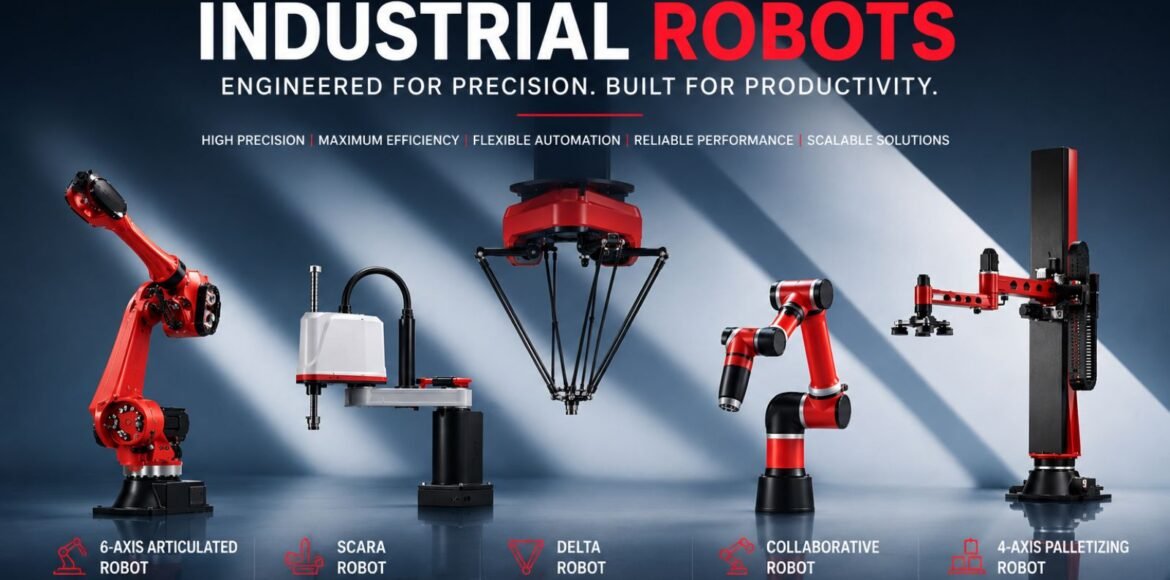
There are seven main types of industrial robots in regular manufacturing use: six-axis articulated robots, SCARA robots, delta (parallel) robots, collaborative robots (cobots), palletizing robots, injection molding manipulators, and 4-axis servo manipulators. Each is built around a different mechanical structure, and that structure — not the brand, not the price — is what actually determines whether a robot can do the job you need it for.
That last part trips up more buyers than it should. Someone shopping for “an industrial robot” for a welding cell and someone shopping for one to pick chocolates off a conveyor are looking for completely different machines, even though both machines get called the same thing. This guide breaks down what separates each type, where it’s actually used, and how to tell early which category you’re even shopping in — before you start comparing individual models.
Key Takeaways Types of Industrial Robots
- Six-axis articulated robots are the most common type, built for tasks needing multi-angle movement — welding, machine tending, material handling.
- SCARA robots move fast on a horizontal plane and are the standard for electronics assembly and pick-and-place.
- Delta robots trade payload for speed, used almost exclusively in fast, light picking — food and packaging lines.
- Collaborative robots (cobots) work safely near people without fencing, and are the fastest-growing category by installation share.
- Palletizing robots handle end-of-line stacking, often the fastest-payback automation on a line.
- Injection molding manipulators synchronize precisely with plastic press cycle timing.
- 4-axis servo manipulators handle straightforward transfer and loading tasks at a lower cost than a full six-axis robot.
Six-Axis Articulated Robots
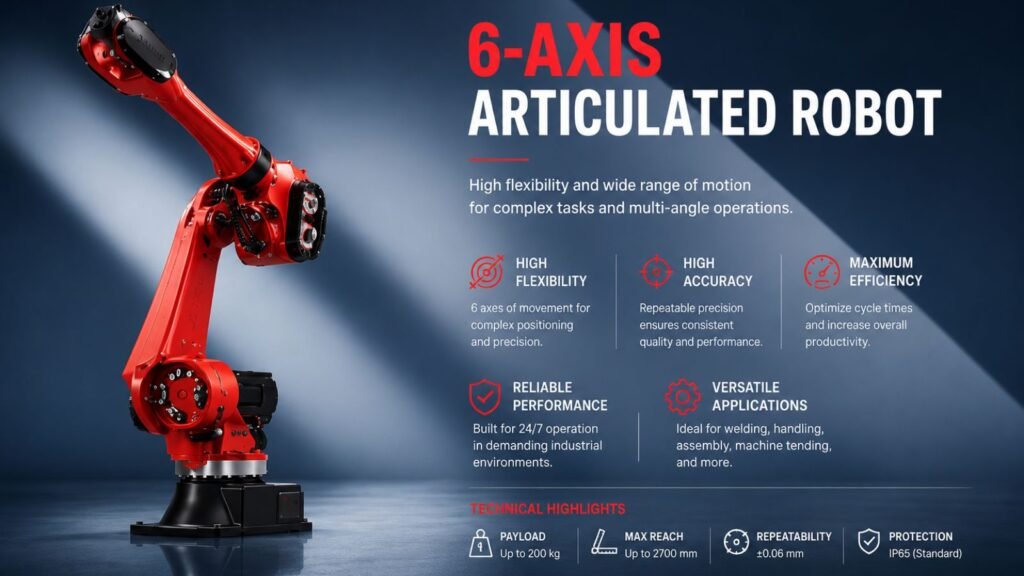
A six-axis robot moves through six independent joints, which is what gives it the flexibility to approach a part from almost any angle — the same reason a human arm can reach over, under, and around an object without repositioning the whole body. That flexibility is why six-axis robots handle the widest range of manufacturing tasks of any single robot type, and why they make up roughly 46–49% of global industrial robot shipments.
Where you’ll find them: welding cells, spray painting booths, machine tending stations, and general material handling. If a task needs the robot to change orientation mid-motion — angling a torch into a joint, spraying a contoured panel — a six-axis robot is usually the only category that can do it cleanly.
Real example: Xiamen Device Technology’s BRTIRUS3012C handles up to 1,000kg at ±0.1mm repeat accuracy, built on the Borunte platform.
SCARA Robots
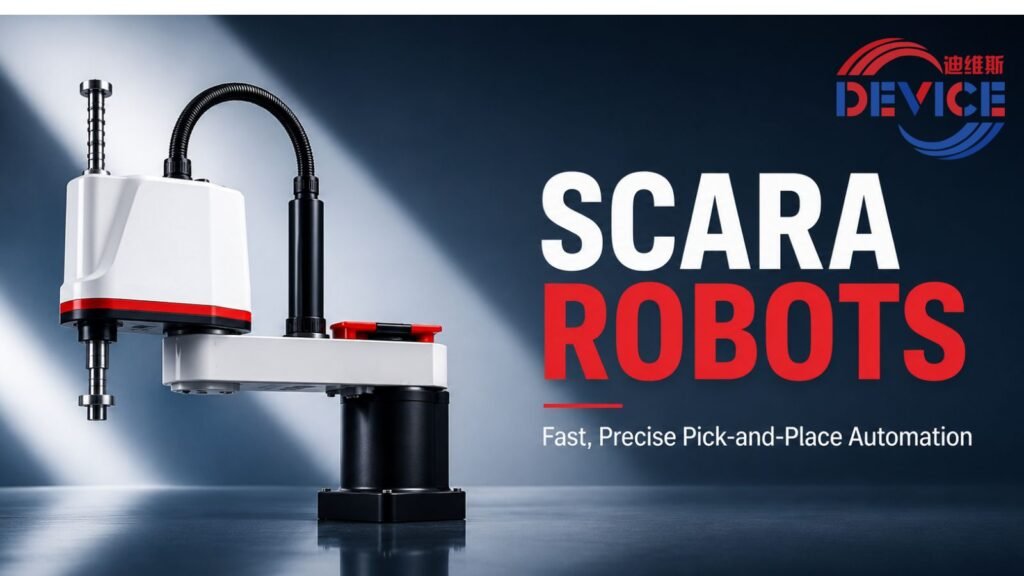
SCARA stands for Selective Compliance Assembly Robot Arm, which is a mouthful for a simple idea: it’s rigid on the vertical axis and flexible on the horizontal plane, so it moves fast and precisely across a flat working area without wobble. Where a six-axis robot spends motion budget on orientation it doesn’t need for a flat task, a SCARA skips straight to speed.
Where you’ll find them: electronics assembly, PCB handling, screwdriving, and small-parts pick-and-place — anywhere the task is fast, repetitive, and doesn’t need the part to be approached from more than one angle.
Real example: the BRTIRSC0603A SCARA platform is built specifically for this kind of high-cycle, planar work.
Delta (Parallel) Robots
Delta robots look different from every other type on this list — three or four arms connect to a shared base overhead, forming a parallel-link structure that trades reach and payload for raw speed. They’re the fastest category here by cycle time, but that speed only pays off with light parts moving through a small, defined workspace.
Where you’ll find them: food packaging lines, pharmaceutical picking, and high-speed sorting — jobs where the part being handled weighs almost nothing and the line is moving quickly enough that a six-axis robot simply can’t keep pace.
(Model-specific delta robot specifications from the current Xiamen Device Technology catalog are to be confirmed — check the full manufacturing robots ranking for the latest availability.)
Collaborative Robots (Cobots)
A cobot is built to work near people without the safety fencing a traditional industrial robot requires, using force-limiting sensors and speed monitoring to stop or slow down before contact becomes dangerous. That single design choice — no fence required — is what’s driving the fastest growth of any robot category: cobots went from 2.8% of global installations in 2017 to 11.9% in 2024, according to the International Federation of Robotics.
The tradeoff is payload. A cobot typically handles 3–30kg, well under what a six-axis robot can carry, but it makes up for that with redeployment speed — a cobot can be moved to a new station and reprogrammed in hours, where a fenced six-axis cell often takes days to relocate.
Where you’ll find them: assembly lines where the task changes often, machine tending in smaller manufacturing operations, and any cell where a human and a robot genuinely need to share the same workspace.
Real example: the BRTIRXZ1005A handles 5kg at ±0.05mm accuracy, with drag-and-teach programming that lets an operator show the robot a motion once rather than writing code.
Palletizing Robots
Palletizing robots do one job — stacking cases, bags, or boxes onto a pallet — but they do it at a pace and consistency that manual labor can’t sustain across a full shift. This is also the category with the most directly measurable ROI on this list: manufacturers deploying palletizing automation have documented 10–30% output increases at the end of the line, since the bottleneck it removes is usually the most visible one in the whole plant.
Where you’ll find them: end-of-line packaging, warehouse and logistics operations, and any process where the final step is getting a finished product from the line onto a pallet for shipping.
Real example: the BRTMD163001A handles 30kg payloads at up to 7 boxes per minute.
Injection Molding Manipulators
This is the most specialized category on the list. An injection molding manipulator exists to do exactly one thing well: synchronize with a plastic injection press’s cycle timing precisely enough that the robot never becomes the bottleneck in the molding process. A general-purpose six-axis robot can technically pull a part out of a mold, but it won’t hit that timing window as tightly — and in plastics manufacturing, that gap compounds fast over a production run.
Where you’ll find them: exclusively in plastics manufacturing — part extraction, insert molding, and in-mold labeling.
Real example: the BRTM09IDS5PC is rated for 160T–320T presses at ±0.05mm accuracy.
4-Axis Servo Manipulators
A servo manipulator gives up two axes of freedom compared to a full six-axis robot, and in exchange, costs less for tasks that never needed those extra axes in the first place — straightforward transfer, loading, and column-mounted palletizing work. It’s the category most buyers skip past, usually because it doesn’t sound as capable on paper as a six-axis robot. For the right task, that’s exactly the point: paying for motion you’ll never use is money left on the table.
Where you’ll find them: material transfer between workstations, column-mounted loading and unloading, and simpler palletizing tasks that don’t need full six-axis orientation.
Real example: the BRTIRPZ2080A handles 80kg at ±0.15mm accuracy.
Quick Comparison Table
| Robot Type | Best For | Typical Payload | Key Advantage |
|---|---|---|---|
| Six-Axis Articulated | Welding, machine tending, handling | Up to 1,000kg+ | Widest task versatility |
| SCARA | Electronics, fast pick-and-place | 1–20kg | Speed and rigidity on a flat plane |
| Delta (Parallel) | High-speed light picking | Under 5kg | Fastest cycle time |
| Collaborative (Cobot) | Shared workspace, changing tasks | 3–30kg | No safety fencing required |
| Palletizing | End-of-line stacking | 10–300kg | Fastest documented ROI |
| Injection Molding Manipulator | Plastics press synchronization | Application-specific | Precise cycle-time matching |
| 4-Axis Servo Manipulator | Transfer & loading | 20–100kg | Lower cost for simpler tasks |
How to Tell Which Type You’re Shopping For
Before comparing brands or specific models, three questions usually narrow this down fast:
- Does the task need the part approached from more than one angle? If yes, you’re looking at six-axis. If it’s a flat, repetitive motion, you’re likely looking at SCARA or delta instead.
- How often does the task change? A line that reconfigures often favors a cobot’s fast redeployment over a fixed six-axis cell, even at a lower payload ceiling.
- Is the task a single, well-defined job — pulling a part from a press, stacking boxes — rather than a general-purpose one? That’s usually a sign you need a specialized category (injection molding manipulator, palletizing robot) rather than a general six-axis platform.
For a side-by-side ranking of all seven types by real installation and growth data, see our full breakdown: Best Industrial Manufacturing Robots in 2026, Ranked.
Frequently Asked Questions
What is the most common type of industrial robot? Six-axis articulated robots are the most common type, accounting for roughly 46–49% of global industrial robot shipments, because their range of motion covers the widest set of manufacturing tasks within a single platform.
What’s the difference between a cobot and a regular industrial robot? A cobot is designed to operate near human workers without full safety fencing, using force-limiting sensors and speed monitoring. Traditional industrial robots typically handle higher payloads and move faster, but require safety fencing or light curtains to separate them from workers.
Which type of industrial robot is fastest? Delta (parallel) robots have the fastest cycle times of any industrial robot type, though only for light parts within a limited workspace — that speed advantage disappears once payload or reach requirements increase.
Can one robot type do the job of another? Sometimes, but usually at a cost. A six-axis robot can technically perform SCARA-style pick-and-place, but it’s slower and more expensive for that specific task than a purpose-built SCARA unit would be.
How do I know which robot type fits my application? Start with the physical path the task requires — flat and repetitive points toward SCARA or delta, while a contoured or multi-angle path needs six-axis flexibility — then confirm payload at full reach and factor in how often the task changes.
This article was written and technically reviewed by Xiamen Device Technology’s engineering team, based on published International Federation of Robotics (IFR) installation data and the company’s own product specifications. For a specific application recommendation, request a quote and an engineer will review your process directly.