

Industrial Robot Supplier: How to Choose the Right Supplier for Your Manufacturing Needs
Choosing the right industrial robot supplier is an important decision for any manufacturer planning to automate its production line. A robot may look like a straightforward piece of equipment, but the right choice depends on much more than payload or arm reach. The robot needs to match the application, production speed, workpiece, factory layout, tooling, safety requirements, and existing machinery.
For manufacturers in India, the USA, Europe, Southeast Asia, the Middle East, and other growing industrial markets, working with an experienced industrial robot supplier can make the purchasing and implementation process much easier.
A reliable supplier should not simply provide a robot. The supplier should help you understand which robot type fits your application, what configuration is required, how the robot can communicate with existing equipment, and what support is available after delivery.
What Does an Industrial Robot Supplier Provide?
An industrial robot supplier provides robotic equipment and related components used for manufacturing and automation applications.
Depending on the project, this can include:
- Six-axis industrial robots
- Four-axis and SCARA robots
- Collaborative robots
- Palletizing robots
- Welding and painting robots
- Injection molding manipulators
- Robot controllers
- End-of-arm tooling
- Sensors and safety equipment
- Automation accessories
However, the scope can vary from one industrial robot supplier to another.
Some companies mainly supply robot hardware, while others provide application assessment, tooling, programming, integration, commissioning, training, and technical support.
For a manufacturer purchasing its first robot, understanding this difference is important. A low-cost robot quotation may not represent the total investment if tooling, programming, integration, installation, and training need to be arranged separately.
Types of Industrial Robots Available from Suppliers
The right robot depends on the manufacturing application. An experienced industrial robot supplier should be able to recommend a suitable platform instead of simply offering the same robot for every project.
Six-Axis Industrial Robots
Six-axis robots provide flexible movement and are widely used for welding, painting, assembly, material handling, machine tending, and other applications that require multi-directional movement.
They are suitable when the robot needs to approach a workpiece from different angles or operate around complex geometries.
SCARA and Four-Axis Robots
SCARA and four-axis robots are commonly considered for fast pick-and-place, assembly, and repetitive handling operations.
Their compact design can be useful where production speed and floor space are important.
Palletizing Robots
Palletizing robots are designed for end-of-line automation. They can arrange boxes, bags, cartons, or other products onto pallets according to a programmed pattern.
The correct system depends on product weight, dimensions, pallet height, required speed, and gripper configuration.
Welding and Painting Robots
Manufacturers can use dedicated robotic systems for welding, painting, spraying, and related production processes.
These applications require the robot to work together with additional equipment such as welding systems, fixtures, spray equipment, tooling, and safety systems.
Collaborative Robots
Collaborative robots, or cobots, are designed for applications where robots may need to work closer to human operators, subject to the appropriate risk assessment and safety requirements.
They can be considered for applications such as assembly, handling, loading, and selected welding operations.
Injection Molding Robots
Injection molding manipulators are designed to work with injection molding machines for tasks such as part removal, insert handling, and product transfer.
The manipulator needs to match the press size, cycle timing, product requirements, and available workspace.
Xiamen Device Technology currently lists multiple robot categories, including six-axis, four-axis, welding, painting, collaborative, palletizing, and injection molding systems, along with related robot components and accessories.
How to Choose the Right Industrial Robot Supplier
Choosing an industrial robot supplier should start with your production requirement rather than the robot catalogue.
Before requesting a quotation, consider the following:
1. Understand the Application
Clearly define what the robot needs to do.
Is it:
- Welding?
- Machine tending?
- Palletizing?
- Material handling?
- Assembly?
- Pick and place?
- Painting?
- Injection molding?
The application determines the robot architecture, payload, reach, tooling, speed, and supporting equipment.
2. Check Payload and Reach
Payload is not simply the weight of the product.
The robot may need to carry the workpiece plus the gripper or other end-of-arm tooling.
Reach is equally important. The robot needs to access every required position without excessive movement or interference with machines, conveyors, fixtures, or operators.
A professional industrial robot supplier should evaluate these requirements before recommending a model.
3. Consider Cycle Time
A robot that can physically perform a task may still be unsuitable if it cannot achieve the required production cycle.
For example, a manufacturer producing hundreds of components per hour may require a different robot configuration from a company handling a smaller production volume.
The industrial robot supplier should therefore consider production speed alongside payload, reach, and repeatability.
4. Ask About Integration
If your factory already has CNC machines, conveyors, injection molding machines, PLCs, sensors, or other equipment, ask whether the industrial robot supplier can support integration.
A robot should be able to operate as part of the production process rather than functioning as an isolated machine.
Why Technical Support Matters
Buying a robot is only one stage of an automation project.
Manufacturers may also need support with:
- Application assessment
- Robot configuration
- Tooling
- Programming
- Installation
- Commissioning
- Operator training
- Troubleshooting
- Spare parts
- Maintenance
This is why choosing an industrial robot supplier based only on the initial equipment price can be misleading.
For an overseas buyer, after-sales support can be particularly important. A factory in India, for example, may need remote technical assistance from a supplier based in China. A customer in Europe or the Middle East may have different documentation, communication, logistics, and compliance requirements.
A supplier with an established international support process can make these stages easier to manage.
Industrial Robot Suppliers for Global Manufacturing
Industrial automation is no longer limited to one manufacturing region.
Manufacturers in India are increasingly exploring robotic automation for automotive components, electronics, packaging, plastics, material handling, and other production applications. Xiamen Device Technology also maintains a dedicated India-focused page covering robot types, applications, export support, and common buyer questions.
In the USA and European markets, manufacturers may place greater emphasis on documentation, safety, integration with existing automation systems, and long-term technical support.
In Southeast Asia, including markets such as Thailand, manufacturers may be looking for automation solutions for material handling, palletizing, welding, and production-line operations.
In the Middle East, industrial automation projects can similarly require reliable equipment, international logistics, technical documentation, and remote or local support.
For international buyers, the role of an industrial robot supplier therefore extends beyond shipping a robot. Export documentation, technical communication, application engineering, and after-sales assistance can all become part of the purchasing decision.
Why Choose Xiamen Device Technology as an Industrial Robot Supplier?
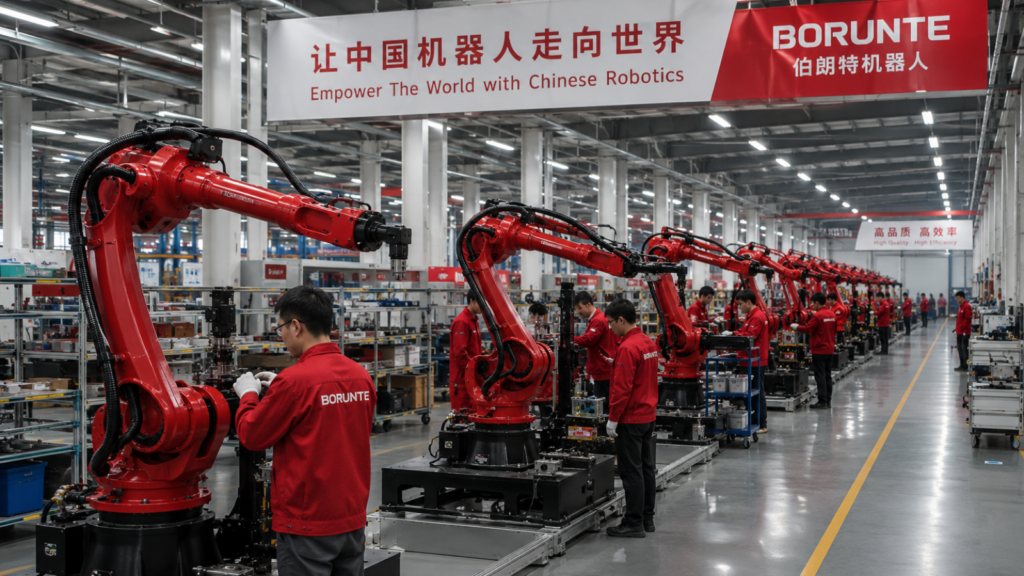
Xiamen Device Technology is a China-based industrial robotics company and authorized Borunte system integration partner serving manufacturing applications in international markets. Its current product range includes more than 85 robot models across several categories.
The company supports applications including:
- Welding
- Material handling
- Machine tending
- Palletizing
- Assembly
- Painting
- Injection molding
- Pick and place
Its engineering approach begins with application requirements such as payload, reach, cycle time, and production conditions rather than selecting a robot based only on a catalogue specification.
For buyers looking for an industrial robot supplier, this application-focused approach can be useful because different production requirements call for different robotic configurations.
Xiamen Device Technology also provides technical support covering feasibility assessment, customized automation solutions, training, spare parts, and after-sales assistance. Its site states that the team typically responds to enquiries within 24 hours for quotation and technical-solution discussions.
The company also documents international deployments, including welding in Russia, painting in Mexico, palletizing in Thailand, and material handling in Argentina.
Frequently Asked Questions About Industrial Robot Suppliers
Before selecting an industrial robot supplier, ask:
Can you recommend a robot based on my application?
The supplier should understand your product, payload, cycle time, reach, tooling, and production requirements.
Can the robot work with my existing machines?
Ask whether the system can communicate with your CNC machines, PLCs, conveyors, injection molding equipment, or other factory systems.
Do you provide tooling and integration?
Find out whether the supplier provides only the robot or can also support tooling, programming, integration, and commissioning.
What support is available after delivery?
Ask about spare parts, training, troubleshooting, remote support, and maintenance assistance.
Can you supply internationally?
For overseas buyers, confirm export documentation, shipping arrangements, technical manuals, certifications, and support availability.
Final Thoughts
Choosing an industrial robot supplier should be based on more than the robot’s purchase price.
The right supplier should understand your manufacturing process and help you select a robotic system that matches the required payload, reach, speed, accuracy, tooling, and production environment.
Whether you are a manufacturer in India looking to automate machine tending, a US company evaluating robotic welding, a European manufacturer planning assembly automation, or a growing factory in Southeast Asia or the Middle East considering palletizing, the selection process should begin with the application.
Xiamen Device Technology provides industrial robot platforms and automation support for different manufacturing requirements, with a product range covering multiple robot types and documented international applications.
If you are comparing an industrial robot supplier for your next automation project, start by sharing your application, workpiece weight, required cycle time, robot reach, and existing production equipment. These details give the engineering team a practical starting point for recommending beyond robotic solution.
abdul
Really useful insights, especially the points about improving automation and production efficiency. Choosing the right automation partner can make a big difference when implementing industrial robots, particularly when it comes to reliability, integration, and after-sales support. The discussion around practical applications makes this a valuable read for manufacturers exploring automation.