
Industrial Robot Applications: Uses, Benefits, Types & Automation Solutions
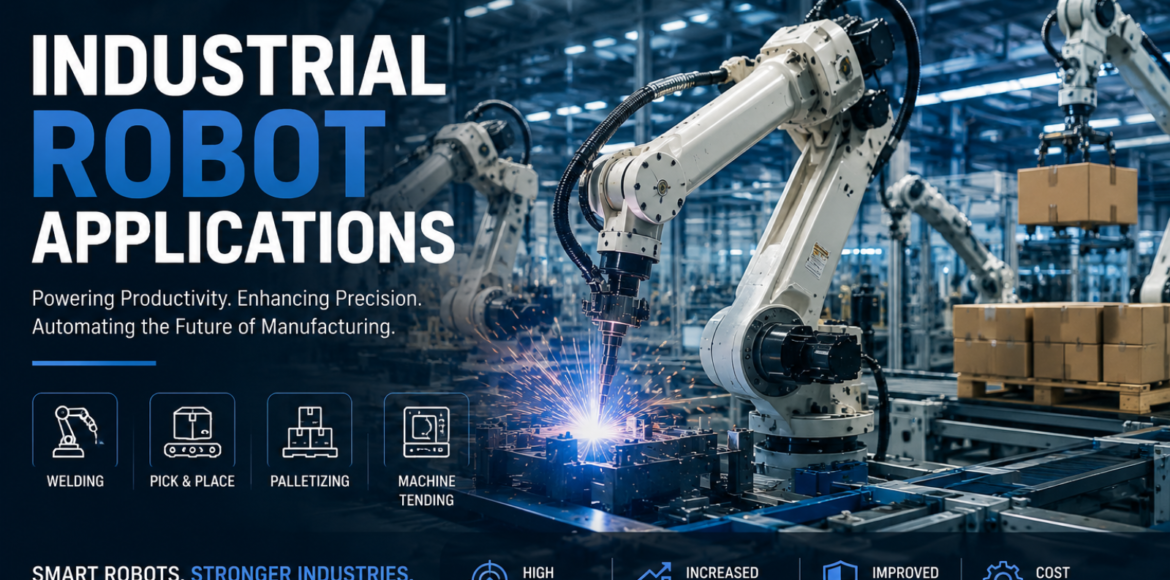
Industrial robots are no longer limited to large automotive factories or highly specialized production lines. Today, manufacturers across industries use robotic systems for welding, material handling, machine tending, palletizing, assembly, packaging, pick-and-place operations, inspection, and many other production tasks.
But what exactly makes a process suitable for robotic automation?
In most cases, it comes down to a combination of repetitive movement, production volume, consistency, payload requirements, cycle time, precision, and workplace conditions. A robot can perform a programmed task repeatedly, but choosing the right robot and designing the right automation system requires a clear understanding of the application.
This is why the concept of industrial robot applications is important. The application should come first, and the robot should be selected according to what that application actually requires.
In this guide, we will look at the most common industrial robot applications, the industries using them, how manufacturers can select the right robot, and how an experienced industrial robot manufacturer such as Xiamen Device Technology can support different automation requirements.
What Are Industrial Robot Applications?
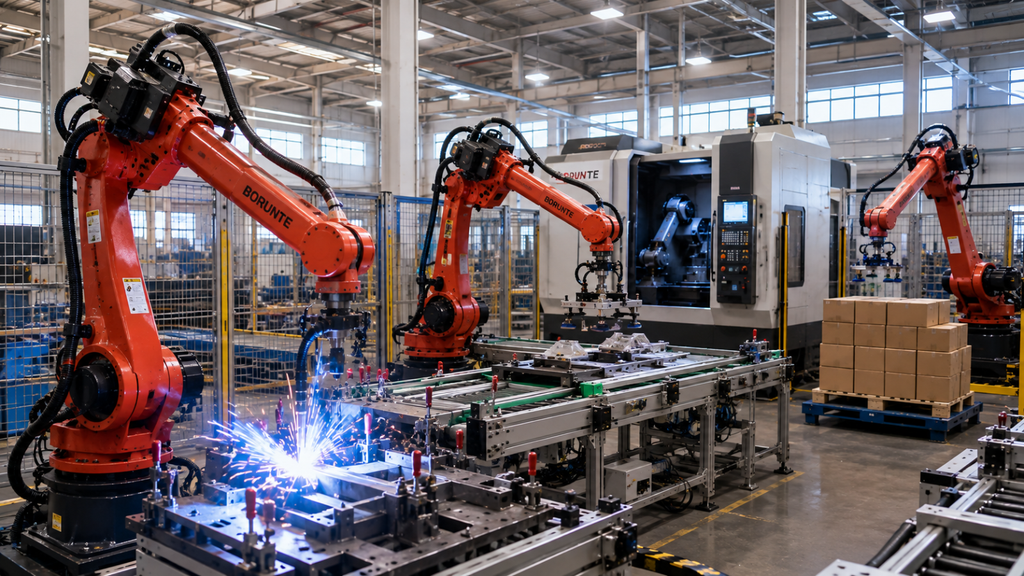
Industrial robot applications are manufacturing tasks performed or assisted by programmable robotic systems.
An industrial robot can be programmed to move, position, pick, place, weld, assemble, load, unload, stack, or handle components according to a defined production sequence.
For example, a robot may take a component from a conveyor and place it into a machine. Another robot may move a welding torch along a predefined path. In a packaging facility, a robot may pick products and arrange them into cartons or onto pallets.
The application determines what type of robot, tooling, controller, sensors, and safety equipment are required.
| Application | Typical Robotic Task |
|---|---|
| Welding | Moving a welding tool along a programmed path |
| Material handling | Moving components between workstations |
| Machine tending | Loading and unloading production machines |
| Palletizing | Stacking products onto pallets |
| Pick and place | Moving products between positions |
| Assembly | Positioning or joining components |
| Packaging | Arranging and handling products |
| Inspection | Positioning products for automated inspection |
The important point is that an industrial robot is not simply a standalone machine. It normally becomes part of a larger automated production process.
Where Are Industrial Robots Used in Manufacturing?
So, where are industrial robots actually being used?
The answer is almost anywhere a manufacturer has a repetitive, structured, or physically demanding production process.
Some applications are relatively simple, such as moving a component from one conveyor to another. Others are more complex and require welding equipment, machine communication, vision systems, specialized tooling, or multiple robots working together.
Let’s look at some of the most common applications.
Robotic Welding
Welding is one of the most established industrial robot applications.
In robotic welding, a robot moves a welding torch along a programmed path while the welding equipment manages the welding process. This can be useful when manufacturers need consistent movements across repeated production cycles.
Robotic welding is commonly considered for fabricated metal components, frames, machinery, automotive parts, and other manufactured structures.
The robot itself is only one part of the system. Welding fixtures, torch equipment, welding power sources, controllers, sensors, and safety systems may all be required to create a complete robotic welding cell.
For manufacturers with repetitive welding operations, the objective is not simply to automate the movement of the torch. The entire process needs to be designed around the required weld quality, component positioning, cycle time, and production environment.
Material Handling
Material handling is another broad area where industrial robots can provide practical automation.
A robot can move components between machines, conveyors, workstations, storage areas, and production lines. This is particularly useful when materials need to be transferred repeatedly throughout a production cycle.
For example, a robot may pick up a finished component from one machine and place it onto a conveyor leading to the next stage of production.
The robot selected for material handling depends on several factors, including the weight and dimensions of the component, required reach, movement speed, tooling, and workspace.
Machine Tending
What happens when operators repeatedly load and unload CNC machines or other production equipment?
This is where robotic machine tending can be considered.
A typical machine-tending application may involve a robot picking up a raw component, positioning it inside a CNC machine, waiting for the machining process to finish, removing the completed component, and transferring it to the next stage.
The exact sequence depends on the machine and production process.
Machine tending can be especially useful for repetitive loading and unloading operations where the production cycle is predictable and components have consistent dimensions.
Palletizing and Depalletizing
Palletizing involves placing products, cartons, bags, containers, or other items onto a pallet according to a defined arrangement.
Instead of manually lifting and stacking products throughout a production shift, a palletizing robot can perform the movement automatically.
Depalletizing works in the opposite direction, with the robot removing products from a pallet and transferring them to another part of the production or logistics process.
Payload, reach, product dimensions, stacking pattern, and cycle time are particularly important when selecting a robot for palletizing applications.
Pick and Place
Pick-and-place automation is straightforward in concept:
Pick the product → move it → place it → repeat.
However, the actual engineering behind a high-speed pick-and-place system can be much more sophisticated.
The robot may need to work with conveyors, sensors, vision systems, grippers, and other equipment. The system may also need to identify product position and orientation before picking it.
Pick-and-place applications are commonly found in packaging, electronics, food processing, component handling, sorting, and general manufacturing.
Robotic Assembly
Assembly is another important industrial robot application.
Depending on the production process, a robot may position components, insert parts, fasten components, or perform other repetitive assembly operations.
Robotic assembly can be useful when manufacturers require consistent positioning and repeatable movements.
The complexity of the application varies significantly. A simple assembly process may require only basic positioning, while a precision application may require sensors, vision systems, specialized tooling, and highly controlled robot movement.
Packaging Automation
Packaging processes often contain repetitive movements that make them suitable candidates for robotic automation.
A robot may pick products from a conveyor, arrange them according to a defined pattern, place them into packaging, or transfer completed packages to another production stage.
The right robotic solution depends on product size, weight, shape, packaging requirements, speed, and available workspace.
Robotic packaging can also be integrated with conveyors, sensors, vision systems, and other automated equipment to create a more complete production line.
Inspection and Quality Control
Industrial robots can also support inspection processes.
For example, a robot can position a component in front of a camera or inspection system. It can also move a component through different inspection positions or transfer products between inspection stages.
When combined with vision and sensing technologies, robotic systems can support automated checks involving dimensions, position, surface conditions, component presence, and product orientation.
The robot does not necessarily perform the inspection itself. Instead, it can provide the controlled movement and positioning required by the inspection system.
Which Industries Use Industrial Robots?
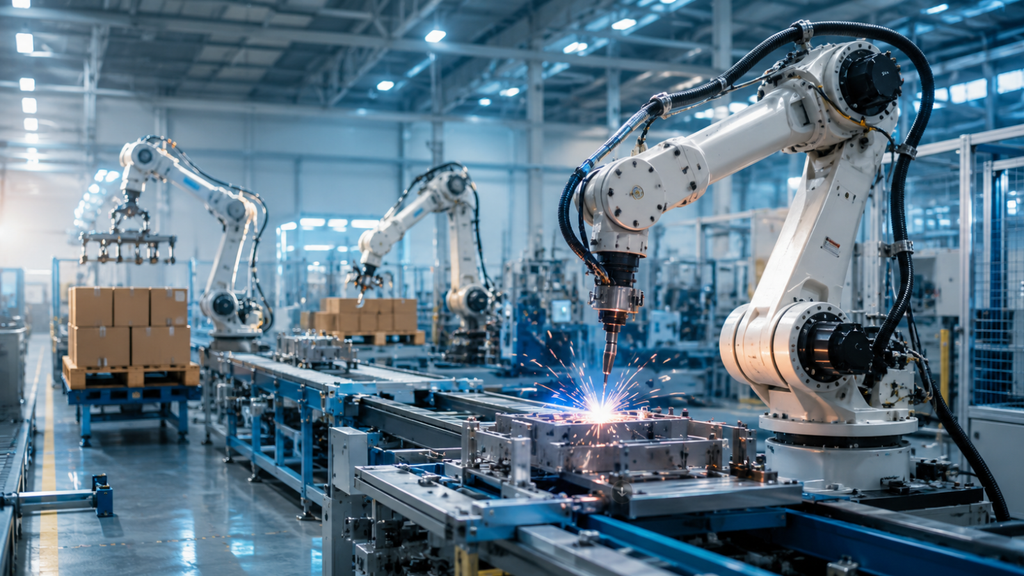
Industrial robot applications can be found across many manufacturing sectors.
| Industry | Common Industrial Robot Applications |
|---|---|
| Automotive | Welding, assembly, handling, machine tending |
| Electronics | Assembly, pick and place, inspection |
| Metal Fabrication | Welding, handling, machine tending |
| Plastics | Machine tending, handling, packaging |
| Food & Beverage | Packaging, sorting, palletizing |
| Machinery | Assembly, welding, material handling |
| Logistics | Picking, sorting, palletizing |
| General Manufacturing | Handling, assembly, packaging and automation |
The specific application varies from one factory to another. Even manufacturers within the same industry may require completely different robotic solutions depending on their products and production processes.
How Do You Choose the Right Industrial Robot Application?
There is no single industrial robot applications that is suitable for.
A robot that works well for high-speed pick and place may not be appropriate for heavy material handling. Similarly, a robot designed for welding may have very different requirements from one used for precision assembly.
Before selecting a robot, manufacturers should consider several factors.
| Selection Factor | Why It Matters |
|---|---|
| Payload | Determines the weight the robot needs to handle |
| Reach | Defines how far the robot must move |
| Cycle Time | Determines the required operating speed |
| Accuracy | Important for precision applications |
| Robot Configuration | Affects movement and flexibility |
| Tooling | Determines how the robot interacts with the product |
| Workspace | Ensures the robot can access required positions |
| Environment | Influences protection and equipment requirements |
| Integration | Determines how the robot works with other machines |
Payload
Payload is not only the weight of the product.
The total load can also include the gripper, welding equipment, tooling, cables, or other equipment attached to the robot.
Therefore, payload needs to be evaluated carefully before choosing a model.
Reach
The robot must be capable of reaching every required position within the work area.
A robot with insufficient reach may not be able to complete the application, while unnecessarily large reach can increase equipment and workspace requirements.
Cycle Time
How quickly does the production process need to run?
If a production line requires a component to be moved every few seconds, the robot must be capable of completing the required movement within that cycle.
End-of-Arm Tooling
The robot needs the appropriate tool to interact with the product.
Depending on the application, this could include a mechanical gripper, vacuum gripper, welding torch, screwdriver, cutting tool, or another specialized device.
Which Type of Industrial Robot Is Used for Different Applications?
Different robot configurations are designed for different movement and production requirements.
| Robot Type | Typical Applications |
|---|---|
| 6-Axis Robot | Welding, assembly, handling and flexible automation |
| Four-Axis Robot | Pick and place, sorting and packaging |
| Delta Robot | High-speed picking and packaging |
| SCARA Robot | Assembly and precision handling |
| Palletizing Robot | Palletizing and heavy product handling |
A six-axis robot, for example, provides a high degree of movement flexibility and can be suitable for applications where the tool needs to approach a component from different directions.
A delta robot, on the other hand, is commonly considered for high-speed picking applications where rapid movement is important.
The correct choice depends on the actual production requirement rather than simply selecting the robot with the highest specifications.
What Are the Benefits of Industrial Robot Applications?
When properly selected and integrated, industrial robots can provide several benefits to manufacturing operations.
Greater Production Consistency
A robot follows a programmed sequence and can repeat the same movement across production cycles. This can help manufacturers maintain consistency in repetitive operations.
Improved Productivity
Robotic systems can perform repetitive operations according to defined production cycles and can be integrated with other automated equipment.
The potential productivity improvement depends on the specific application, production volume, robot configuration, and system design.
Reduced Repetitive Manual Work
Some manufacturing operations require workers to repeatedly lift, move, position, or transfer products.
Automating these repetitive movements can allow operators to focus on other production, supervision, quality, or maintenance activities.
Better Process Control
Robotic systems can be integrated with controllers, sensors, vision systems, PLCs, conveyors, and production machinery.
This allows manufacturers to coordinate different parts of a production process through a structured automation system.
However, automation should not be viewed as simply putting a robot wherever a manual process exists. The application needs to make technical and operational sense.
Is an Industrial Robot Enough to Automate a Production Process?
Not usually.
An industrial robot is an important part of an automation system, but a complete robotic application may require several additional components.
| System Component | Purpose |
|---|---|
| Industrial Robot | Performs programmed movement |
| Robot Controller | Controls robot operation |
| End-of-Arm Tooling | Handles or processes the workpiece |
| Sensors | Detects process conditions or positions |
| Vision System | Identifies, locates or inspects products |
| Fixtures | Holds and positions components |
| Conveyor | Moves products or materials |
| PLC/Control System | Coordinates equipment |
| Safety System | Helps protect operators and equipment |
This is why robotic automation should be considered as a complete system rather than only a robot purchase.
Successful integration requires the robot to work correctly with the surrounding machinery, tooling, controls, safety systems, and production workflow.
Industrial Robot Applications from Xiamen Device Technology
Selecting the right robot requires an understanding of the application, not just a product specification sheet.
Xiamen Device Technology focuses on industrial robotics and automation solutions designed around different manufacturing requirements.
As an industrial robot manufacturer serving manufacturing and automation needs, Xiamen Device Technology works across applications such as robotic welding, material handling, palletizing, pick and place, machine tending, assembly, packaging, and other industrial automation processes.
The company’s approach is application-focused because different production requirements call for different robotic configurations.
For example, a high-speed pick-and-place application may prioritize movement speed and lightweight tooling, while a material-handling application may require greater payload and reach. A welding application may require a suitable robot configuration together with welding equipment, fixtures, and safety systems.
Understanding these differences is an important part of developing an effective automation solution.
Application-Focused Robot Selection
A practical robotic project begins by understanding the production process.
The manufacturer needs to know:
- What is being handled?
- How much does it weigh?
- How quickly must the operation be completed?
- How far does the robot need to reach?
- What type of tooling is required?
- How much workspace is available?
- What machines need to communicate with the robot?
- What safety requirements apply?
These requirements help determine the appropriate robotic configuration.
Supporting Different Manufacturing Requirements
Xiamen Device Technology’s industrial robotics capabilities can support manufacturers looking to automate different stages of production.
Whether the requirement involves welding a component, moving materials between machines, palletizing finished products, tending CNC equipment, or performing repetitive pick-and-place operations, the robotic solution needs to be matched to the actual manufacturing process.
This application-driven approach helps manufacturers look beyond the robot itself and consider the complete automation system.
How Can a Manufacturer Start Using Industrial Robots?
For a manufacturer considering robotic automation for the first time, the process does not need to begin with automating the entire factory.
A better approach is to identify one production process where automation could provide meaningful value.
1. Identify the Repetitive Process
Start by looking at operations that involve repeated movement, loading, unloading, lifting, positioning, welding, stacking, or handling.
2. Define the Production Requirements
Determine the product weight, dimensions, cycle time, required reach, accuracy, tooling, and working environment.
3. Select the Appropriate Robot
Based on these requirements, determine which robot configuration and payload class are suitable.
4. Design the Complete Robotic System
Consider the robot, controller, tooling, fixtures, sensors, conveyors, safety systems, and machine communication.
5. Test, Integrate and Optimize
Before full production, the robotic system needs to be tested and adjusted to ensure that the complete application works as intended.
This process helps manufacturers approach automation based on actual production requirements rather than simply choosing equipment based on specifications.
Frequently Asked Questions About Industrial Robot Applications
What are the most common industrial robot applications?
Common applications include welding, material handling, machine tending, palletizing, depalletizing, pick and place, assembly, packaging, inspection, sorting, and loading and unloading production equipment.
What industries use industrial robots?
Industrial robots are used across automotive, electronics, metal fabrication, machinery, plastics, packaging, food and beverage, logistics, and general manufacturing.
Which industrial robot is best for manufacturing?
There is no single robot that is best for every manufacturing application. Robot selection depends on factors such as payload, reach, cycle time, accuracy, movement requirements, tooling, workspace, and integration requirements.
Can small and medium-sized manufacturers use industrial robots?
Yes. A manufacturer does not necessarily need to automate an entire production line. A single repetitive process, such as machine tending, palletizing, welding, or material handling, can be considered as a starting point for automation.
How do I choose an industrial robot?
Start with the application. Determine the required payload, reach, cycle time, accuracy, tooling, workspace, and environmental conditions. These requirements can then be used to identify a suitable robot configuration.
What is the difference between an industrial robot and a robotic automation system?
An industrial robot is the programmable robotic machine. A complete robotic automation system can include the robot, controller, tooling, sensors, fixtures, conveyors, safety equipment, PLCs, software, and integration with other production machinery.
Can industrial robots be customized for different applications?
Yes. Industrial robotic systems can be configured with different tooling, fixtures, sensors, software, and integration methods depending on the manufacturing process.
Is robotic automation suitable for repetitive production work?
Repetitive production tasks are often strong candidates for robotic automation, particularly when the process requires consistent movement, positioning, handling, or cycle times.
Finding the Right Industrial Robot Applications
Industrial robots can support a wide range of manufacturing processes, but successful automation starts with understanding the application.
Welding, material handling, machine tending, palletizing, pick and place, assembly, packaging, and inspection all have different technical requirements. The robot therefore needs to be selected according to the task, rather than choosing a robot first and trying to fit it into the production process afterward.
For manufacturers exploring automation, the most useful questions are simple: What process is repetitive? What needs to be moved or handled? What payload and reach are required? What cycle time must be achieved? And how should the robot integrate with the existing production line?
With experience in industrial robotics solutions and automation solutions, Xiamen Device Technology helps manufacturers explore robotic solutions based on their specific production requirements.
If you are evaluating an industrial robot applications, sharing details such as the application, workpiece weight, required cycle time, working range, and production process can be the first step toward identifying a suitable robotic automation solution.